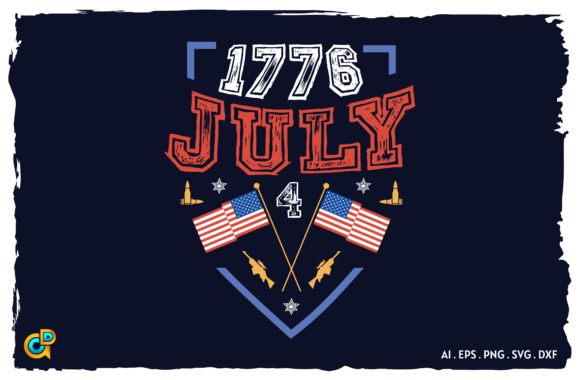
1776 JULY 4 SVG Design
A Designer’s First Look: Clean, Patriotic—But Does It Stitch Well?
When I opened the 1776 JULY 4 SVG Design file for a client’s Independence Day tote bag project, my first impression was straightforward: it’s bold, centered, and intentionally minimal—no flourishes, no stars-and-stripes clutter. Just crisp block lettering with subtle serif weight on “1776” and clean sans-serif for “JULY 4.” It feels like a quiet nod to heritage—not a parade float. That restraint is promising for embroidery, where simplicity often translates to cleaner stitching, better fabric drape, and fewer thread breaks.
Real-World Use: From Sweatshirt to Nursery Pillow
I tested the 1776 JULY 4 SVG Design across three real projects: a medium-weight cotton canvas tote (for a local boutique), a lightweight baby onesie (organic cotton, 5.5 oz), and a structured twill cap. On the tote, it stitched cleanly at 4.5" wide using standard tear-away stabilizer—no puckering, no distortion. The letterforms held their shape, and the spacing between “1776” and “JULY 4” gave breathing room for satin-stitched edges.
On the onesie? More careful handling was needed. The design’s tight internal corners—especially in the “4” and lower curve of the “6”—required reduced stitch speed and lightweight cut-away stabilizer underneath. Without it, the fill stitch bunched slightly near the base of the “J.” Not a dealbreaker—but a reminder that this isn’t a “drop-in-and-stitch” file for ultra-delicate baby embroidery without prep.
The cap test revealed its limits: the design’s horizontal width stretches the front panel just enough to distort on curved surfaces unless digitized with underlay and pull compensation. As-is, it works best on flat or gently contoured items—tote bags, pillow covers, tea towels—not high-crown caps or structured beanies.
Where It Shines—and Where to Pause
This 1776 JULY 4 SVG Design excels in contexts where clarity and quiet confidence matter: small shop merchandise, handmade holiday gifts, personalized kitchen towels for Fourth of July hostess sets, or minimalist nursery decor (think: embroidered linen pillow cover beside a red-white-and-blue quilt). Its lack of dense fill areas means lower stitch density—ideal for lightweight fabrics and faster turnaround on custom apparel orders.
Use caution on:
- Stretchy fabrics (like jersey tees) without proper stabilizer—it lacks built-in underlay, so stretching can blur letter edges;
- Dark or textured fabrics (e.g., heavy terry cloth towels), where fine detail in the “J” or thin serifs may get lost without contrast testing;
- Hoop sizes under 4 inches—scaling down compresses spacing and risks legibility loss in satin-stitched outlines;
- Layered garments (like reversible aprons), where backside thread nesting could show through light fabrics.
What It Adds to Your Finished Product
When executed well, the 1776 JULY 4 SVG Design elevates perceived value—not through complexity, but through intention. Customers notice clean lines, balanced proportions, and typography that reads instantly, even from across a craft fair booth. For Etsy sellers, that translates to stronger thumbnail recognition in search results and higher engagement on mockups. For boutique owners, it supports brand consistency when paired with neutral palettes and natural fibers.
It also builds trust: buyers recognize thoughtful design when they see consistent stitch tension and uncluttered spacing. No hidden knots, no over-digitized shadows—just honest, functional embroidery. That matters especially for personalized gifts and wedding weekend merchandise, where sentiment meets craftsmanship.
Practical Notes Every Embroidery Designer Should Check
Before cutting fabric or sending to production, here’s what I do—and recommend you do—with the 1776 JULY 4 SVG Design:
- Test on scrap fabric first, using your exact thread colors and stabilizer combo—especially if stitching on cotton-linen blends or performance knits;
- Review stitch density in your embroidery software; if fill areas feel too sparse for your fabric weight, add a light underlay;
- Confirm hoop size compatibility—this design fits comfortably in a 5x7 hoop, but verify dimensions before scaling for smaller patches or larger sweatshirt backs;
- Inspect small details at 200% zoom: check whether the inner counter of the “6” or the crossbar of the “4” will clear cleanly on your machine;
- Test black-and-white mockups—this design relies on shape and proportion more than ornament, so grayscale previews reveal clarity issues faster than color;
- Compare light vs. dark fabric backgrounds—the design’s moderate stroke weight holds up well on both, but always preview thread contrast (e.g., navy thread on cream canvas reads sharper than pale yellow on white);
- Use appropriate stabilizer: tear-away for stable wovens, cut-away for knits, and fusible + tear-away for lightweight linens;
- Verify licensing for commercial embroidery use—if selling finished products or digital embroidery files, confirm the seller permits POD, Etsy resale, or small business distribution.
Final Thought: A Solid, Scalable Craft Asset
The 1776 JULY 4 SVG Design isn’t flashy—but it doesn’t need to be. In the Crafts category, especially for Graphics aimed at makers and small shops, reliability trumps ornament. It’s a versatile anchor piece: pair it with simple star motifs for holiday embroidery, layer it subtly behind monograms for wedding gifts, or use it solo on a linen tea towel for a boutique kitchen line. It respects the fabric, honors the machine, and gives customers something timeless—not trendy. That’s the mark of a design built for real work, not just pretty previews.